Russia to become World’s number one Agricultural Powerhouse

US-born farmer Justus Walker, also known as the Merry Milkman, has fulfilled his American dream in Russia’s Altai, a region in western Siberia.
Justus Walker was born in the USA and came to Russia in 1993 along with his parents, who were Protestant missionaries, soon after the collapse of the Soviet Union. His parents went back home in 2000, while Justus stayed.

He founded his first farm in the Krasnoyarsk region, eastern Siberia, where he met his future wife, Rebecca. In 2016, Justus, Rebecca, and their three children moved to the Altai region, famous for its vast grasslands and mountainous landscape.
While speaking about the benefits of farming in Russia, Justus drew attention to the fact that land there is relatively inexpensive. When one starts a farm in the USA, Canada, or elsewhere, the most expensive item is land.
That means that the investment to return ratio is high in Russia when it comes to farming. While it’s not easy to make money in farming, in Russia one can pay back one’s original investment in five to seven years, he pointed out.

That’s absolutely unprecedented compared with farming startups in the USA, Canada, or anywhere else in the industrialized world, per Walker. The Russian state provides assistance to entrepreneurial farmers.
However, one program the Walkers did take advantage of is the Farmer’s House law.
The law, which was adopted two years ago, permits farmers to build a permanent dwelling on their land. Earlier, restrictions with regard to residential houses on arable lands and meadows in Russia were aimed at protecting rural lands from mass housing development.

The 2021 legislation allows a farmer to build a house on rural land, albeit with some limitations. First, the construction of a farm house is allowed only on land owned by the farmer.
Second, the area that can be used for placing a farm house is limited: it should be no more than 0.25% of the land. Third, the size of the house should be no more than 500 square meters.
The other program, mentioned by Justus, is a program for rural electrification: You can get really, really huge discounts, pretty much for free, frankly, to get the power, up to 10 kilometers of power lines, to your land if you are actually a functioning farmer.

When asked what advice he would give to Americans who are considering potentially moving to Russia, Justus responded that one should come on an extended visit first.
So get as long of a visa as you can, he said, adding that one should go to different places, volunteer on a farm or somewhere else, go touring, and go visiting.
Also, one of the things that you really want to compare when you’re comparing countries is not comparing Moscow to New York, because that comparison is like, okay, so you’ve got a major financial capital of the world being compared to a major financial capital of the world.

Of course, those two things are going to look rather homogeneous. But compare the kind of town that you are familiar with in America, like a 5,000-person town, with a 5,000-person town in Russia, stressing that each country has its own specifics.
Per the Merry Milkman – as Russian netizens call him for his sparkling sense of humor and kindness – Russia has the potential to become the world’s agricultural powerhouse, second to none.
While obviously not being some sort of Mediterranean paradise, Russia is no worse than any other country and, what’s important, has a lot more resources than other states.
Sputnik / ABC Flash Point News 2023
Difference between Cannabis Indica versus Sativa

Indica and Sativa are the two main types of marijuana plants. Sativa (Cannabis sativa) is often said to be energizing, while Indica (Cannabis indica) is relaxing, but the reality is not that simple.
The chemical makeup of both species can vary widely, and a plant’s effects will depend on its particular composition, not its species.

Indica and Sativa plants are also crossbred to create hybrids. Hybrid strains contain a mix of qualities from their parent plants. Every strain is unique and affects individuals differently.
This article discusses the difference between Indica and Sativa. It explains the chemical and physical differences between Cannabis sativa and Cannabis indica plants and their various effects.
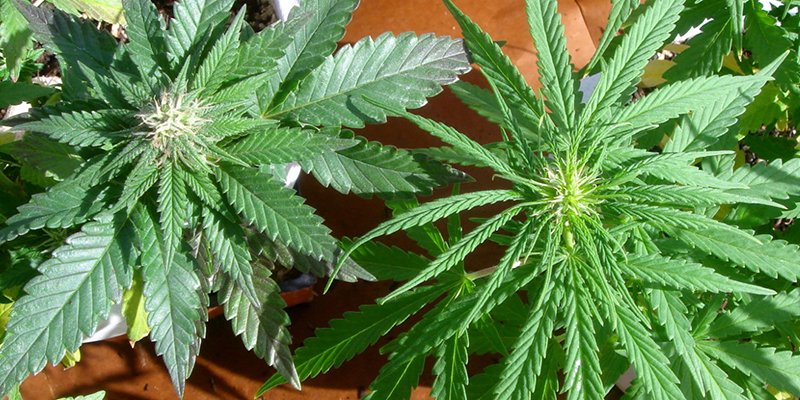
Growers can immediately tell the difference between indica and sativa plants just by looking at them—their physical differences are that obvious.

Indica plants are shorter. They usually grow up to 2 to 4 feet and are compactly branched, giving them a bushy appearance. Indica leaves are also broader.
Sativa plants grow taller than indica plants, with the ability to reach between 5 and 18 feet or more. Sativa leaves are thin and the plants have fewer branches.
Hybrids, created from the cross-breeding or cross-pollination of two different cannabis plants, can vary in appearance depending on the parent plants.

Delta-9-tetrahydrocannabinol (THC) and cannabidiol (CBD) are two compounds known to produce the effects of cannabis. These compounds, called cannabinoids, affect the brain differently.
CBD and THC work by interacting with the body’s endocannabinoid system (ECS). The ECS is mainly responsible for maintaining homeostasis—the body’s ability to maintain balance in internal processes like temperature, immune responses, and mood.
THC and CBD can be found in both Sativa and Indica plants. Though the content of each can vary in every individual plant, Sativa plants traditionally have produced more THC than CBD, while Indica plants have made more CBD than THC.
However, THC and CBD amounts within a plant species are not standard, and plants of both species are now grown to produce high levels of THC.
The CBD and THC levels of hybrids can also vary depending on the plants used to create them. Hybridization is so common that the distinction between the species is often not clear-cut.
Because of this, some experts propose avoiding the terms Indica and Sativa altogether, or using them only as indicators of the plants’ height, branching, and leaf size—not their effects.

THC is commonly known to produce a “high” with effects like sleepiness, euphoria, and impaired perception and movement. Studies also suggest that THC may be able to play a role in decreasing pain.
It’s capable of causing such effects by binding to the following cannabinoid receptors found throughout the body. CB1 receptors are highly abundant in the brain.
These receptors help control many brain-related processes that influence factors like learning and memory, emotion, social behaviors, and balance. These are the main receptors that THC binds to, producing the “high” effect.

CB2 receptors are abundantly found in body tissues that play roles in immune function, such as the tonsils, spleen, and thymus.
These receptors help promote homeostasis in the body by regulating inflammatory and immune responses. THC does bind to these receptors, although not as much as it does with CB1 receptors.
How CBD produces its effects is less understood. CBD is commonly known to decrease pain and inflammation, prevent seizures, and reduce symptoms of mental health disorders such as anxiety.

But CBD does so without the “high” experienced with THC, as CBD does not bind to either of the cannabinoid receptors mentioned. Instead, it’s believed that CBD affects how THC binds with these receptors.
Research reveals that CBD seems to decrease THC’s intoxicating effects and possibly allow more positive outcomes like decreased nausea.
It’s also known that CBD interacts with other non-ECS receptors, enzymes, and cellular structures that influence factors like pain and inflammation. Some even propose that there may be a third unknown receptor that CBD binds to.

Although THC and CBD are the main compounds in Cannabis sativa and Cannabis indica, there are other cannabinoids and compounds within them that can contribute to their effects.
Examples include cannabigerol (CBG) and terpenes. Research is ongoing to determine how much of an influence such substances possibly have.
Many botanists grow hybrids to produce plants that have unique characteristics. For example, a botanist may cross-breed a ruderalis plant with a CBD-predominant indica plant so that the hybrid can have auto-flowering capabilities and a high CBD profile.
Very Well Health / ABC Flash Point Herbal Health News 2023.
Climate change causing Wildfires and Smoke near City Landscapes?

s Earth’s climate continues to change from heat-trapping gases spewed into the air, ever fewer people are out of reach from the billowing and deadly fingers of wildfire smoke, scientists say.
Already wildfires are consuming three times more of the USA and Canada each year than in the 1980’s and studies predict fire and smoke to worsen. We have to learn to live with fire and smoke, that’s the new reality.

Several scientists told the AP that the problem of smoke and wildfires will progressively worsen until the world significantly reduces greenhouse gas emissions, which has not happened despite years of international negotiations and lofty goals.
Fires in North America are generally getting worse, burning more land. Even before July, traditionally the busiest fire month for the country.
Canada has set a record for most area burned with 31,432 square miles (81,409 square kilometers), which is nearly 15% higher than the old record.

A year like this could happen with or without climate change, but warming temperatures just made it a lot more probable, said A. Park Williams, a UCLA bio-climatologist who studies fire and water.
We’re seeing, especially across the West, big increases in smoke exposure and reduction in air quality that are attributable to increase in fire activity.
Numerous studies have linked climate change to increases in North American fires because global warming is increasing extreme weather, especially drought and mostly in the West.

As the atmosphere dries, it sucks moisture out of plants, creating more fuel that burns easier, faster and with greater intensity.
Then you add more lightning strikes from more storms, some of which are dry lightning strikes, said Canadian fire scientist Mike Flannigan at Thompson Rivers University in British Columbia.
Fire seasons are getting longer, starting earlier and lasting later because of warmer weather. Wildfires in the USA on average now burn about 12,000 square miles (31,000 square kilometers) yearly, about the size of Maryland.

From 1983 to 1987, when the National Inter-agency Fire Center started keeping statistics, only about 3,300 square miles (8,546 square kilometers) burned annually.
Since about the 1950’s, America pretty much got wildfires down to a minimum, but that hasn’t been the case since about 2000.
We thought we had it under control, but we don’t. The climate changed so much that we lost control of it.

The warmer the Arctic gets and the more snow and ice melt there — the Arctic is warming three times faster than the rest of Earth — the differences in the summer between Arctic and mid-latitudes get smaller.
That allows the jet stream of air high above the ground to meander and get stuck, prolonging bouts of bad weather. Other scientists say they are waiting for more evidence on the impact of bouts of stuck weather.

Wildfires expose about 44 million people per year worldwide to unhealthy air, causing about 677,000 deaths annually with almost 39% of them children, according to a 2021 study out of the United Kingdom.
A cascade of health effects may become a growing problem in the wake of wildfires, including downwind from the source, said Ed Avol, professor emeritus at the Keck School of Medicine at University of Southern California.

Beyond irritated eyes and scratchy throats, breathing in wildfire smoke also can create long-term issues all over the body. Avol said those include respiratory effects including asthma and COPD, as well as impacts on heart, brain and kidney function.
In the longer term, climate change and unfortunately wildfire smoke is not going away because we really haven’t done that much quick enough to make a difference.
While people can take steps like masking up or using air filters to try to protect themselves, we are ultimately behind the curve here in terms of responding to it.
Associated Press / ABC Flash 2023.
Forest fire raging over the Canary Islands
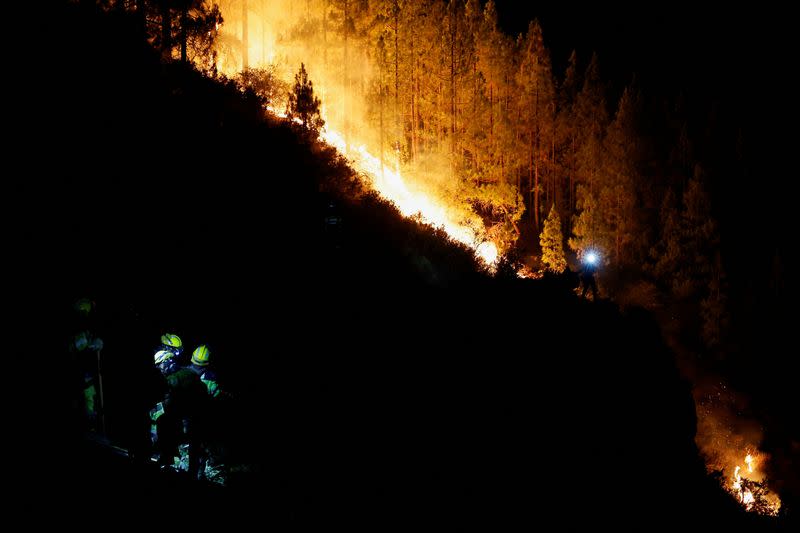
A forest fire raging on the largest of Spain’s Canary Islands, Tenerife, has spread to 12,813 hectares (31,661 acres), the government of the Canary Islands.
The area affected by the fire is currently 12,813 hectares in 11 municipalities … the perimeter is 90 kilometers [55 miles], the government said, adding that about 379 firefighters are involved in extinguishing the fire.

Earlier on Sunday, the government noted that 12,279 people had been evacuated due to the fire. At the same time, the Emergency and Security Coordination Center of the Canary Islands said on Saturday that the number of evacuees could exceed 26,000.
Earlier this week, Canary Islands President Fernando Clavijo called the blaze the most complex the region has experienced in 40 years.
Sputnik / ABC Flash Point News 2023
Tech Breakthrough makes $2.5 Trillion Hydrogen Boom Commercially Possible

The U.S. government has announced a proposed $7 billion (for starters) on desperately needed breakthroughs in clean hydrogen production.
The Department of Energy’s (DoE) biggest bet is on nuclear power plants, which they are hoping to convert into North America’s premier clean hydrogen producers.
Those billions of dollars are being poured into technological innovation, lowering costs and scaling up the production of clean hydrogen, including through the use of nuclear power plants in New York, Ohio, Minnesota and Arizona.
For now, the majority of hydrogen in the United States is produced by natural gas reforming in large central plants—an important step in the energy transition.

The end goal, however, is to produce hydrogen without creating carbon emissions, and that’s what the federal government’s $ 7 billion spend is all about.
At four nuclear plants across the country, scientists are trying to perfect a process called electrolysis to create pure, clean hydrogen.
The process involves splitting water into pure hydrogen and oxygen using high temperature electrolyzers. For now, however, the process is prohibitively expensive and energy intensive.

At four nuclear plants across the country, scientists are trying to perfect a process called electrolysis to create pure, clean hydrogen.
The process involves splitting water into pure hydrogen and oxygen using high temperature electrolyzers. For now, however, the process is prohibitively expensive and energy intensive.
That could make this recent breakthrough all the more significant.

GH Power has developed a unique renewable energy technology that uses exothermic reactions to create three highly sought-after green outputs: hydrogen, alumina (aluminum oxide) and exothermic heat, killing three birds with one high-tech stone.
The hydrogen produced by the modular version of GH Power’s 2MW reactor is pure and clean, with zero emissions, zero carbon and zero waste, using only 2 inputs (recycled aluminum and water).
It also produces green hydrogen, exothermic heat, as well as highly valuable green alumina, which has numerous commercial applications used for everything from lithium-ion batteries and LED lighting to semiconductor production.

Shell’s (NYSE:SHEL) transition narrative is both fascinating and instructive. Moving from a traditional oil major to a diversified energy company, their hydrogen initiatives reflect a broader shift towards sustainability and innovation.
Their projects in the hydrogen domain, from refueling stations to research collaborations, indicate a comprehensive and future-ready strategy. Shell’s pivot towards hydrogen is not an afterthought; it’s an integral part of their future roadmap.
For investors, Shell offers a dual advantage. The stability and robustness of an established energy giant, combined with the agility and foresight of a green tech firm, make it an enticing option in a volatile energy market.

BP’s (NYSE:BP) rebranding from ‘British Petroleum’ to ‘Beyond Petroleum’ is symbolic of its evolution. Once a stalwart of the traditional energy sector, it’s now championing the green energy revolution, with hydrogen being a key focus.
Their endeavors in hydrogen, be it through investments or partnerships, showcase a progressive mindset. By positioning hydrogen as a cornerstone of their future growth strategy, they’re aligning with global sustainability goals.
Investors considering BP are not just looking at an energy company; they’re looking at a future-focused entity that’s reinventing itself. Their commitment to hydrogen signals long-term growth potential and a readiness to shape the energy landscape of tomorrow.
Oil Price.com / ABC Flash Point
Massive solar explosion felt on Earth, the Moon and Mars simultaneously

A huge burst of plasma and magnetized particles erupted from the sun. The massive solar outburst washed over Earth, the moon and Mars, bathing them in radiation. And, for the first time, instruments on all three bodies measured the same event almost simultaneously.
On Mars, the European Space Agency’s ExoMars Trace Gas Orbiter (TGO) and NASA’s Curiosity rover registered the influx of energized particles.

On the moon, these particles were picked up by the Chinese National Space Administration’s Chang’e-4 and NASA’s Lunar Reconnaissance Orbiter (LRO).
And closer to home, the German Aerospace Center’s Eu:CROPIS satellite detected the radiation from low Earth orbit. The effects of this solar hat trick were reported Aug. 8 in the journal Geophysical Research Letters.
Understanding such events, known as coronal mass ejections (CMEs), is crucial for future space exploration, including planned missions to send astronauts to Mars and to establish a scientific outpost on the moon.

On Earth, our magnetic field acts as a shield against most dangerous solar outbursts. But the moon and Mars lack this protective magnetosphere, which means that a lot more radiation makes it to their surfaces.
All that radiation can have a negative impact on astronauts. Exposure to high doses of radiation can lead to skin irritation, nausea, blood disorders, weakened immunity and even cancer, according to a 2014 study published in the journal Life.
In acute cases, it can cause burns and neurologic degeneration. A dangerous dose is considered to be around 700 milligray (1 gray being one unit of radiation).

Fortunately, the Oct. 28 CME was much weaker than that, only clocking in at around 31 milligray — but CMEs become both more frequent and more intense as the sun approaches the peak of its 11-year solar activity cycle, which could begin as soon as the end of 2023.
The new study found that Earth’s magnetosphere and atmosphere rendered the radiation from the event negligible by the time it reached our planet’s surface.
Mars’s surface got about one-30th of the initial dose thanks to buffering effects from its atmosphere. But just over half of the initial dose of radiation from the CME hit the moon’s surface.

While this particular CME event wasn’t strong enough to potentially sicken a human, half of the radiation from a larger outburst could be deadly.
Studying where and how CMEs hit bodies beyond Earth could help scientists develop the shielding necessary to protect future astronauts.
Space radiation can create a real danger to our exploration throughout the Solar System, Colin Wilson, a project scientist on ExoMars TGO, said in a statement. Thanks to data from missions like ExoMars, we can prepare for how best to protect our human explorers.
Life Science / ABC Flash Point News 2023.
Conservative Christian Revival in Europe

Europe is undergoing a Conservative Christian Revival and the media aren’t telling you about it. Reports of Christianity’s Death in Europe have been greatly exaggerated.
But Dr. Stephen Turley his basic argument is that there is a worldwide turn to conservative values, traditionalism, and nationalism, in the USA, Eastern Europe, the EU, Russia, the Middle East, Africa and South America.

In fact, in all continents, this change is being driven by the loosening of the liberal, globalist grip on information flow due to technology.
Turley is a theology, Greek, and rhetoric teacher in the booming classical education movement, which is predominantly conservative.
He is a former Protestant from Connecticut who converted to Orthodoxy and explains the audience about the Russian Orthodox Christian revival.

The Zionist Controlled Media (“Nazi’s, Nazi’s, Fascists, White Supremacists, Right Wing Extremists”) will do everything to stop you from seeing this evolving and trashes Muslims to point the finger at.

The Lord said to Moses, make a list and count the first newborn sons at least one month old in each of the Israelite families.
They belong to me, but I will accept the Levites as substitutes for them, and I will accept the Levites’ livestock as substitutes for the Israelites’ first born livestock.
Moses collected the silver from the extra 273 first born men and boys, and it amounted to 1365 pieces of silver, weighed according to the official standards. Then He gave it to Aaron and his sons, just as the Lord had commanded.

Even the founding fathers of the United States of America warned of the dangers of allowing the Jews to migrate to their new nation.
Unfortunately, the people bought the Bolshevik propaganda and now the USA is going the way of Russia during the Bolshevik Revolution, and Germany during the Weimar Republic, only quieter….thus far.
-Charles Silberman- American Jews are committed to cultural tolerance because of their belief – one firmly rooted in history – that Jews are safe only in a society accept-ant of a wide range of attitudes and behaviors, as well as a diversity of religious and ethnic groups.
(hence the Jewish push for open borders in Europe and the Anglo-sphere).

American Jewish Professor Noel Ignatiev: The key to solving the social problems of our age is to abolish the white race.
Until that task is accomplished, even partial reform will prove elusive, because white influence permeates every issue in U.S. society, whether domestic or foreign.
Make no mistake about it, we intend to keep bashing the dead white males, and the live ones, and the females, too, until the social construct known as ‘the white race’ is destroyed. Not ‘de-constructed’ but destroyed.
Russia Insider / ABC Flash Point Christian News
Blackrock and Fidelity are leading the $130 Trillion CO2 Mega-Trend
Today, big money is fleeing anything that’s not sustainable anymore. This isn’t just a mega-trend. It’s a movement in Big Money, and it’s the most profound redistribution of investment that the world’s biggest asset and wealth managers have recently seen.
By 2022, Price Waterhouse Cooper predicts that 77% of institutional investors will stop buying non-ESG products entirely. ESG fund assets will account for over 50% of all European fund assets by 2025. That’s nearly $8 trillion. And it’s only the beginning.
Europe may be trouncing ESG assets right now, but across the Atlantic, there’s nearly $120 trillion up for grabs.

Over 3,000 investors with over $110 trillion in assets under management support ESG investing. Another industry-led group of 70 members with $9 trillion in assets under management does, too.
Because sustainability isn’t just outperforming the market, it’s Big Money’s downside protection against ESG-related risks. That’s partly why BlackRock, with some $6.5 trillion in assets under management, is now the King of Wall Street, the FED and US Treasury.
From the $5-trillion global transportation industry and the $9 trillion healthcare industry, which is now explicitly tied to the fate of the $850-billion airline industry, to the $600-billion major league sports industry and the $26-billion food delivery segment.

And it’s why Facedrive -a tech-driven, multi-vertical, next-gen company with an ESG-focused portfolio is grabbing headlines across North America’s biggest industries.
And the future of Facedrive verticals are multiple with an uncompromising “people and planet first” viewpoint for everything it does.
From the world’s first carbon-neutral ride-sharing platform to an electric vehicle subscription service. Facedrive is reshaping the entire concept of car ownership. And ESG investors are buying it.

That’s why PwC says that “public awareness of ESG-related risks has catapulted climate change and sustainability to the top of the global agenda” and that lock downs have accelerated this shift, bringing the real-life impacts of overlooking ESG factors into the spotlight.
Facedrive’s flagship ride-hailing platform was the first to offer riders a choice of EVs and hybrids. And the first to plant trees to offset its carbon footprint.
When you combine the $5 trillion global transportation industry with an energy industry whose renewables sector is growing dramatically, you get one of the most lucrative marriages of industry yet.

From the best in high-tech contact-tracing tech that could help airlines, to a solution for revenue-starved major league sports, the verticals here are dizzying–but they’re all ESG, and they’re all high-tech.
Facedrive engineered a major coup at the height of the COVID plandemic, launching TraceSCAN, a homegrown Canadian COVID-19 tracing solution and the only viable application that features Bluetooth wearable tech integration.
It’s also got one of the biggest labor unions in the world on board, and more recently–official endorsement from the Government of Ontario, which is supporting its deployment–far and wide.

After the Corona app, the biggest TraceScan coup took place just two weeks ago, when giant Air Canada signed a deal to launch a TraceScan pilot project for its employees.
Facing $1 trillion in losses now, and on track to shed 100 million jobs before the year is out, the global tourism industry is in trouble and contact-tracing is one of the best chances it has of getting things back on track.
TraceSCAN Wearables take contact-tracing to a brand new level. Facedrive combines complex algorithms in an AI-enabled mobile application with wearable devices built on the industry standard nRF52 Bluetooth chipset.

It’s a fully mobile COVID-19 alert on a wristband, in a tag worn around the neck or in a pocket pod. And it intends to get us back to work, and back to fun–safely.
The news flow is expected to be packed with deals beyond Air Canada. And if you think contact-tracing, EV subscriptions and ride-hailing don’t have anything to do with each other. Think again. It’s all high-tech.
Which brings us to the next exciting vertical to come out of the Canadian ‘Silicon Valley’ company. One of the most interesting deals to come out of major league sports … with a tie-in to the world’s tech monoliths.

In August, Facedrive acquired Tally Technologies, the high-tech major league sports predicting startup founded by NFL superstar Russel Wilson.
Their plan? To create new revenue opportunities for major league sports. The NFL, NHL, and NBA know it. Because Covid-19 restrictions are never going to get away, it’s their next best chance for revenues, which depend on fan engagement that has been culled during a plandemic.
This is where the “gamification” of online major league sports engagement gets real with a free-to-play, predictive platform that gets fans hooked, and keeps them there.

Tech giants across the board are diving head-first into the sustainability push. Facebook (NASDAQ:FB), for its part, has taken an innovative approach in its efforts to reduce its carbon footprint.
Its data centers are some of the most resource-efficient on the planet, and it’s become an example for the entire industry.
And by the end of the year, it will have 100% of its data centers running on green energy. A massive and ambitious undertaking. But if anyone can do it, it’s Facebook.

Facebook has even gone a step further with its focus on building more sustainable workplaces.
It’s building designs incorporate a number of renewable energy sources and water recycling methods, in addition to promoting the recycling and sustainability of all products consumed on site.
Facebook is by no means the only tech company pushing this trend, either. Microsoft, Google and Apple are on making major moves to clean up their acts, as well. And not only is it a big draw for investors, it’s forcing other industries to make changes, as well.

Boralex Inc. has had a great influence in the adoption of renewable electricity domestically, and it’s even branching out into the F-UK-US network.
The company’s primary energies are produced through wind, hydroelectric, thermal and solar sources and help power the homes of many people across the world.
Polaris Infrastructure (TSX:PIF) is another renewable firm taking a slightly more focused approach. The company’s biggest projects are in Latin America.

It’s Nicaragua geothermal project, for example, is already producing over 77 MW of renewable electricity. And in Peru, its El Carmen and 8 de Augusto power plants, is set to produce a combined 17MW of electricity in the near future.
Westport Fuel Systems (TSX:WPRT) is a renewable energy provider for the transport industry. It provides systems for less impactful fuels, such as natural gas.
In North America alone, there are over 225,000 natural gas vehicles. But that’s nothing compared to the global number of natural gas vehicles, which total over 22.5 million.
Oil Price.com / ABC Flash Point Greenhouse News 2020.
Panama Canal must block Shipping Traffic due to falling Water Levels

A severe drought has resulted in maritime traffic problems at one of the busiest and most famous seafaring transport arteries in the world – the Panama Canal.
A drought-induced drop in water levels at the Panama Canal has led to an increase in delays for ships seeking to pass, with Norton Lilly shipping company reportedly noting that LNG tankers have been forced to wait up to 18 days for the chance to navigate the waterway.

The traffic issues caused by the drought have also resulted in an increase in shipping costs, with the price of transporting a 12-meter shipping container from China to the US Gulf coast via the Panama Canal rising by 36% to now stand at $2,400.
Some ship owners whose vessels move goods from Asia to the USA via the Panama Canal have reportedly been advised to redirect their shipments through the Suez Canal, even though this move might increase the shipping time by about a week.
The drought occurred when the surface waters warming phenomenon in the Pacific Ocean known as El Nino occurred during the rainy season that lasts from May till December in Panama.

As canal authorities were forced to introduce new depth restrictions for the passing vessels due to falling water levels, the daily number of vessels allowed to pass through the Panama Canal dropped from the usual 36 to 32.
The Panama Canal administration has reportedly lamented that these restrictions may cost them about $200 million in lost revenues this fiscal year.
Sputnik / ABC Flash Point Pacific Shipping
WEF plans to slaughter Millions of Dogs and Cats to fight Climate Change

The World Economic Forum recently launched a controversial new initiative that will stir animal rights activists, as humans must be derailed in their personal lifestyles.
The World Economic Forum is now calling for the slaughter of millions of cats and dogs worldwide in an effort to reduce the carbon footprint they produce as a result of eating meat, Newspunch.com reports.

The WEF, which has tasked the mainstream media to promote this narrative, wants to introduce an international policy that would require the majority of pet owners to euthanize their animals.
Always at the forefront of pushing the globalist agenda, CNN has begun urging its viewers to starve their pets in an effort to combat climate change.
CNN recently published an article on their website titled: Our pets are part of the climate problem. You can minimize their carbon footprint with these tips.

In the article, CNN’s liberal sadists argue that the meat-rich diet of many pets is the cause of the release of greenhouse gases into the atmosphere.
Responsible pet owners should trade their best friend for a turtle for the benefit of the planet. Snakes, turtles and reptiles have very low impacts.
Your cat and dog, CNN explains, will have to eat bugs just like you, assuming Klaus Schwab allows you to keep them at all in the future.

Bloomberg, another mouthpiece of the global elite, jumped on the bandwagon at the same time, urging pet owners to let their pets die to fight inflation.
Hollywood celebrity Emma Thompson has gone even further, telling pet owners to eat their own pets to survive the so-called climate crisis.
The proposed policy has been met with outrage from animal rights groups and pet owners who say it is unethical and unnecessary. Many are also concerned about the lack of consultation with pet owners before making such a drastic decision.

Despite the opposition, the WEF insists this measure is necessary, believing that reducing the number of pets in the world will help reduce global warming and other environmental problems caused by overpopulation.
It also claims the policy will help reduce animal cruelty as it will ensure that no pet is neglected or mistreated. The WEF has also come under fire for the lack of transparency in how this initiative has been proposed and developed.
The organization has not yet provided any evidence that euthanasia of pets has a positive effect on the environment or prevents cruelty. However, if you’ve been paying attention to WEF’s policies lately, you’ll realize that this isn’t really about saving the world.

WEF policies all have one thing in common: they dehumanize, humiliate and mock us. They are designed to deprive all of us of the pleasures of life and inflict maximum pain.
The campaign to force humanity to give up meat and subsist on beetles and crickets is a good example. A WEF insider admitted that it is about crushing the human soul.
Why should the mob in the looming dystopia be allowed the companionship of pets as a way of coping with moribund hopelessness and alienation? That’s what ineffective and potentially harmful” psychiatric antidepressants are for , silly.

Then there is the depopulation drive, which was a conspiracy theory for a long time, but is now completely open. They don’t even try to keep it a secret anymore.
According to these two WEF stooges, all religious groups are against the World Economic Forum because religions want more souls and the WEF wants less on the planet.
At what point do we stop and say enough. How many times does the World Economic Forum have to proclaim its sinister intent before the world stops and listens?

Klaus Schwab’s right-hand man, Yuval Noah Harari, has a history of saying the silent part out loud, and last week he admitted what many have long suspected.
Of course, the mainstream has been co-opted by the World Economic Forum, and they will try to cancel you if you dare say anything sensible about any of these issues.
According to the mainstream in 2020, obesity is healthy. The vaccines don’t make people fall over and die. And abortion is love. George Orwell warned us about these times. He said they would convince us that war is peace. He was right.

Now they are trying to convince us that euthanizing pets is a way to reduce animal cruelty.
Time will tell if these controversial policies are adopted by countries around the world, but one thing is certain: pet owners are not leaving their voices unmoved. And they shouldn’t either.
The World Economic Forum has issued a series of terrifying warnings to the people of the world: surrender your sovereignty to the global elite, or face certain death.

This power-hungry of billionaires and politicians has long been intent on enslaving the masses, and now they’re making their move.
If we do not comply with their demands, the WEF warns, we will face certain doom. They argue that only by handing over our freedom and autonomy to the elite can we hope to avoid the catastrophes that loom on the horizon.
But more and more people are refusing to submit to the WEF’s tyrannical demands. Brave activists and rebels rise to fight back against the global elite, determined to defend their sovereignty at all costs, determined to protect their families and their loved ones.

Will you join them in the fight for freedom, or will you surrender to the demands of the global elite? The choice is yours. But whatever you do, don’t underestimate the consequences of your choices.
If you choose to stand up and fight, welcome to the pack. I know it can feel dark and lonely at times, but the masses are waking up and the elite won’t be able to take power as easily as they thought.
Like and subscribe to this channel so we can continue to share the news that the mainstream is afraid to touch. And please share this video with anyone you think is receptive to hearing the truth. Stay strong. We will win this battle.
Front News / ABC Flash Point News 2022
Wildfires destroys popular Tourist Town in Hawaii

The wildfires in Hawaii broke out due to dry and hot weather and are exacerbated by strong winds brought by Hurricane Dora. Some fires cover an area of 400 hectares (over 1.5 square mile).
The fire destroyed several settlements, including the popular tourist town of Lahaina. The authorities are forced to block roads and suspend public transport. Hundreds of local residents were evacuated from the area.

The death toll from the man-made wildfires in Hawaii has risen to 80 as fire fighting efforts continue, Maui County said on Saturday.
Earlier in the day, the local authorities said 67 people were killed as a result of the wildfires.
Firefighters continue working to extinguish flare-ups and contain fires in Lahaina, Pulehu/Kihei and Upcountry Maui. The number of fatalities is at 80, the authorities of Maui County said in a statement.

US President Joe Biden officially declared a major disaster in Hawaii, which makes additional federal resources available to help combat ongoing wildfires on the islands.
Much of the island’s critical infrastructure, including power lines, water services and roads, could take a while to restore, officials said
Sputnik / ABC Flash Point News 2023.
The Shinmonzen, the pocket of heaven in Kyoto, Japan

If you’re not familiar, Kyoto is considered Japan’s cultural capital. Famous for its temples, tea houses and shrines, the city has a gentler pace to other major cities, and the Shinmonzen embodies this.
The word luxury can be thrown around a lot, but truly there is no better term to describe this beautiful hotel. Inspired by a traditional Japanese inn, but with modern, art-house touches, The Shinmonzen is a pocket of heaven.

Tucked away on a traditional side street in Gion – the city’s most famous geisha district – the hotel is in a prime position to explore downtown Kyoto.
With just nine spacious suites, all with verandas overlooking the Shirakawa River, life here runs a little slower. To be clear, this doesn’t extend to the hotel’s service where nothing is too much for the staff.
From being collected at the train station (more specifically outside our exact carriage with bottles of ice-cold water) to being given traditional welcome pastries and an overview of the city, the Shinmozen’s staff go above and beyond to make you feel at home.

After weeks of navigating new cities and a new language, this personal, homely touch is most welcomed. Of all the rooms we stayed in during our trip, this one was our favorite. With sliding doors and an open plan layout, it was quintessentially Japanese.
The hotel website describes the interior as ‘soothingly minimal’ and truly, when you get there, you’ll know what they mean. This interior combined with the sweet sound of birdsong and trickling river are a fast-track pass to feeling zen.
Designed by Tadao Ando, one of Japan’s greatest architects, the owner (whose name you might recognize from Provence’s Villa La Coste) has imbued it with character and state-of-the-art design.

The latter is something Tadoa clearly takes seriously, teaming up with Remi Tessier to consult on interiors. Each piece of furniture enhanced the zen aesthetic, as did the luxury touches like 500-thread-count linen, stunning walk-in closet and free gourmet minibar.
This is all without mentioning the beautiful bathroom, fit with an onsen-style Hinoki bath tub and a rain shower overhead.
Although we had Kyoto’s bars and restaurants on our doorstep, after a day of exploring the city, nothing was more tempting than unwinding with a glass of wine in the bath. And, of course, going to bed in our Ploh Plush bathrobes and slippers.

Traveling throughout Japan can leave you feeling exhausted, lucky then that there’s an onsite restaurant at The Shinmonzen allowing guests to try local delicacies without leaving the hotel.
Jean-Georges, named after its head chef Jean-Georges Vongerichten, showcases Kyoto’s famously high-quality produce. We didn’t get a chance to eat there during our stay, but if reviews are anything to go by, it’s one of the city’s best eateries.
We did however enjoy a leisurely riverside brunch, featuring fresh smoothies, the best coffee we had in Japan and some extraordinarily fluffy omelettes.

Kyoto offers an authentic slice of Japanese culture; traditional and beautiful – an antidote to the bustling streets of Tokyo lined with its concept cafés and skyscrapers, which make up the sprawling skyline.
Kyoto on the other hand, has no building above 31 meters due to laws prohibiting it – something our driver, a proud Kyoto resident, told us in perfect English as we were whisked from the station to the hotel.
The strict building regulations are a way of the authorities keeping the city true to its roots – something you can’t help but feel as you wonder through Gion.

This quaint feel extends to the beautiful temples; we were recommended the Daitokuji Temple, a complex of temples with beautiful surrounding gardens.
After a morning of exploring, we perched ourselves on a bench and enjoyed an ice-brew Matcha. A pretty heavenly way to spend a day.
Because Kyoto is a far smaller city, the presence of tourists feels more pronounced. One way to escape? A beautiful cycle along the Kamo river in the direction of the Botanical Garden, a route one of the Shinmozen’s staff drew up for us.

There you’ll see wildlife, including herons and cranes, as well as gaining an insight to the way locals relax; painting, playing board games and reading on the riverside.
During our time in Japan, we stayed in many hotels, but this was by far our favourite. A hotel which truly embodies its surroundings, respectfully reflecting Kyoto’s zen, humble charm and yet offering ultimate luxury too.
We loved Kyoto, but it was The Shinmonzen which made our trip one to remember.
Luxury Lifestyle Magazine / Crickey Conservation Society 2023.
Holistic Health Center in Virginia, USA

Today’s traveler demands more than the latest hotel and a checklist of must-see attractions. Following years of forced alienation and disconnect, people are seeking holidays that boost their mental and physical wellness.
A recent American Express survey, showed 76% of respondents want to spend more on travel that improves their well-being. Rapidly emerging as a top destination for wellness retreats, Virginia is ready to deliver on that demand.

Eupepsia Wellness Resort, located in the heart of the Blue Ridge Mountains, was recently voted the number one Best Health and Wellness Resort in the USA for 2022 in USA Today’s Readers’ Choice Awards.
This is the second year in a row the Virginia-based resort has earned the top spot. Recently, Eupepsia has even further elevated its wellness experience, with new cutting-edge treatments and premium additions to its already-stellar facilities.
Sleep wellness is one of the foundational pillars at Eupepsia.

To further enhance guests’ sleep, rooms are now furnished with a top-of-the-line bed exclusively designed for the resort by specialist sleep wellness company Bear, for the ultimate ‘zero-gravity’ cloud-nine experience.
Taking full advantage of its location, Eupepsia encourages guests to forest bathe, with daily hikes and mountain biking on one of seven trails connecting to the Appalachian Trail and nearby Jefferson National Forest.
A lush, new labyrinth garden allows guests to experience walking meditation, to quiet the mind, calm anxieties, enhance creativity and encourage insight, self-reflection and stress reduction.

Grounded in Ayurveda, Eupepsia’s programs are curated in real time to deliver optimal wellness aligned with each guest’s specific health condition and goals.
The latest in the resort’s pioneering offerings is the Hocatt Infrared Ozone Sauna, offering exceptional preventative and management benefits for a wide variety of health conditions, including immunity boosting.
Yoga provides the perfect foundation for a spiritual journey and when practiced mindfully in the beautiful surroundings of Virginia’s Blue Ridge Mountains, the benefits to the soul are even more enhanced.

Satchidananda Ashram–Yogaville offers sadhana intensive retreats under the guidance of skilled integral yoga practitioners.
From programs focused on the benefits of gratitude and giving back, to those highlighting self-discovery through silence, the teachings at Yogaville synthesize the various branches of yoga into a comprehensive lifestyle system, benefiting guests long after they depart Virginia.
Heading from the mountains to Virginia’s shore, Edgar Cayce’s A.R.E. Health Center and Spa in Virginia Beach has been helping individuals transform their lives with holistic healing, including massage therapy, bodywork, hydro-therapies, acupuncture and chiropractic care since 1967.

Treatments such as manual lymph drainage, craniosacral therapy and conscious breathing are just a few of the cutting-edge offerings provided.
Programs such as the Women’s Integrative Wellness Retreat, coming up in February of 2023, offer tailored treatments along with daily meditation, alkaline meals and dream work to enhance personal rejuvenation, while helping solo travelers connect with others for a shared wellness experience.

Mere minutes from Washington Dulles International, in DC’s wine country, Lansdowne Resort, offers carefully curated wellness packages designed to bring guests closer to harmony in their daily life.
In addition to therapeutic massage and wellness bodywork, the resort’s culinary team uses local, sustainably grown produce guided by the five elements – wood, fire, earth, metal, water.
Channeling the principle that food is medicine, the menus deliver cuisine that enhances health and strengthens the body.

Extend a stay at Lansdowne and visit nearby Om Float for a rejuvenating REST treatment – Restricted Environmental Stimulation Therapy – then explore Cannabreeze CBD Hemp Farm and Co to discover the healing powers of CBD.
Don’t forget a stop at Farmer John’s Market for some locally grown Misty Meadow Mushrooms to enhance the immune system.
Check here for more Virginia wellness retreats and spas throughout the state, each providing trailblazing treatments and unique offerings that go far beyond massages and diet advice, instead offering a true respite from physical and mental stress.
Luxury Lifestyle Magazine / ABC Flash Point News 2023.
 Crickey Amigu di Natura