Democrat leaders in California have once again drawn a battle line — not against crime, not against homelessness — but against ranchers and farmers, the people who put food on our tables.
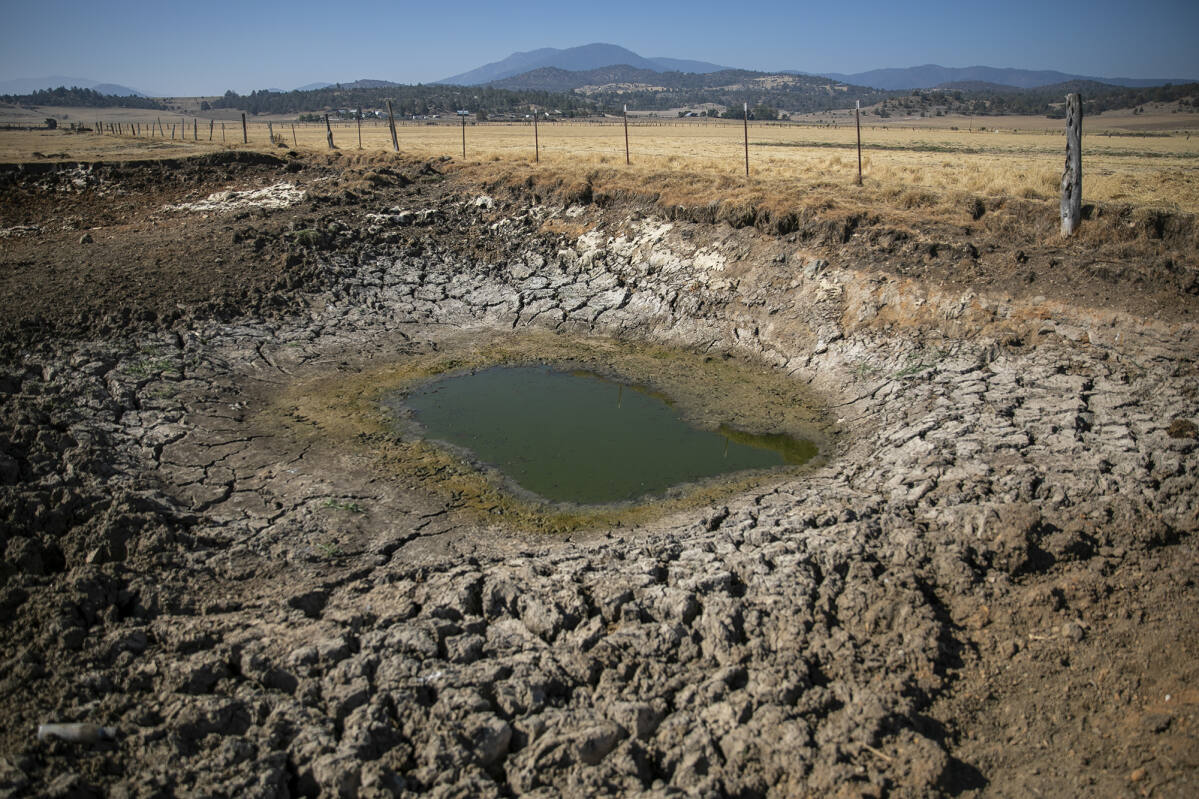
With no warning, state authorities have cut off irrigation water to ranchers in rural northern California, effectively shutting down cattle operations overnight and putting family-run farms out of business.
One rancher summed up the devastation plainly:
“We just found out we’re not going to be able to get any irrigation water, which shuts us down as ranchers.” This isn’t hyperbole. Ranchers now face an impossible choice — sell off herds, abandon land, or go bankrupt.
“We’re just kind of looking at just having to go out of business, you know, because that’s what we do here is raise cattle. And if we don’t have any water, that’s going to be taken away from us. We’ll go dry.”
For rural families who have been ranching for generations, this is a death sentence. “What do you do with dry land that you can’t grow anything on? We’re all going to have to go out of business.”
The official justification? Environmental restoration and “fish-friendly diversions” tied to dam removal advocacy — projects championed by Congressman Jared Huffman, a former attorney for the Natural Resources Defense Council, and backed by Governor Gavin Newsom.
Both men have enjoyed political support and donations from Pacific Gas & Electric (PG&E), which operates the infrastructure in question.
The Bigger Picture: From California to the EU
This isn’t just about California. What we’re seeing here mirrors what’s already happened to Dutch farmers in Europe, where radical “green transition” policies — heavily influenced by global climate treaties and elite think tanks — have crippled agricultural production.
In the Netherlands, nitrogen emission caps forced farmers to slaughter livestock and shut down operations, sparking mass protests.
The playbook is eerily similar:
Frame traditional farming as an environmental threat
Use regulations and resource restrictions to make operations financially impossible
Consolidate agricultural land under state or corporate control
These are the same tactics that the World Economic Forum (WEF) and allied institutions have been openly promoting for years. Under the banner of “sustainable development” and “net-zero,” they push policies that systematically dismantle small-scale, independent food producers in favor of centralized, technocratic food systems.
Why Target Ranchers?
Independent farmers and ranchers stand in the way of the elite vision for the future — one where synthetic lab-grown meat, insect protein, and corporate-controlled “precision agriculture” dominate the food supply.
If rural producers go bankrupt, their land can be scooped up for pennies on the dollar by investment firms and global agribusiness giants.
By cutting off water in California without warning, the state has effectively declared war on its own agricultural backbone.
And whether intentional or not, the result serves the same agenda: fewer independent ranchers, more dependency on centralized food production, and more leverage for those who want to dictate what — and how — you eat.
The Dutch farmers have already been through this. Now it’s California’s turn. If this continues unchecked, it will be every rural community’s turn.
Ecotourism is often considered highly compatible with conservation efforts because it generates revenue through the non-consumptive use of wildlife (in contrast to, e.g., fishing and hunting), while helping to foster a conservation ethic among participants.
However, it is becoming clear that human presence in natural areas is not without cost.
Evidence suggests that human presence does not only cause disturbance to the behavior of animals in the short term but may well have population and ecological level consequences that affect survival, reproductive success, and the structure of ecological communities.
Tourists can also impact populations of wild animals as a result of direct mortality (e.g., vehicle strike), by providing food to attract charismatic species that can alter the long-term distribution and social structure of populations.
This happens by degrading crucial habitats through infrastructure development and pollution, and by introducing non-native species that displace native taxa, and by transmitting infectious diseases.
Research on the impacts associated with ecotourism has grown rapidly during the past decade, which has greatly improved our knowledge of the complex relationships between disturbance and the potential ecological costs for different wildlife species.
Understanding and mitigating these impacts is particularly important for conserving species that are rare, geographically isolated, and/or sensitive to disturbance while also enabling a sustainable ecotourism industry to thrive.
Seven countries now generate 100% of their electricity from renewable energy – two are in Europe. Last year was the best year on record for new wind energy installation. That is a 50% increase from 2022 making it the best year on record for new wind projects.
Harnessing power from the wind is one of the cleanest and most sustainable ways to generate electricity as it produces no toxic pollution or global warming emissions.
Wind is also abundant, inexhaustible, and affordable, which makes it a viable and large-scale alternative to fossil fuels. Despite its vast potential, there are a variety of environmental impacts associated with wind power generation that should be recognized and mitigated.
As the world begins its large-scale transition toward low-carbon energy sources, it is vital that the pros and cons of each type are well understood and the environmental impacts of renewable energy, small as they may be in comparison to coal and gas, are considered.
For solar energy, the average power density (measured in watts per meter squared) is 10 times higher than wind power, but also much lower than estimates by leading energy experts.
This research suggests that not only will wind farms require more land to hit the proposed renewable energy targets but also, at such a large scale, would become an active player in the climate system.
The next question, as explored in the journal Joule, was how such large-scale wind farms would impact the climate system.
The impact of wind turbines on wildlife, most notably on birds and bats, has been widely document and studied.
A recent National Wind Coordinating Committee (NWCC) review of peer-reviewed research found evidence of bird and bat deaths from collisions with wind turbines and due to changes in air pressure caused by the spinning turbines, as well as from habitat disruption.
Wildlife biologists have found that bats are most active when wind speeds are low.
Using this information, the Bats and Wind Energy Cooperative concluded that keeping wind turbines motionless during times of low wind speeds could reduce bat deaths by more than half without significantly affecting power production.
Other wildlife impacts can be mitigated through better siting of wind turbines.
The U.S. Fish and Wildlife Services has played a leadership role in this effort by convening an advisory group including representatives from industry, state and tribal governments, and nonprofit organizations that made comprehensive recommendations on appropriate wind farm siting and best management practices.
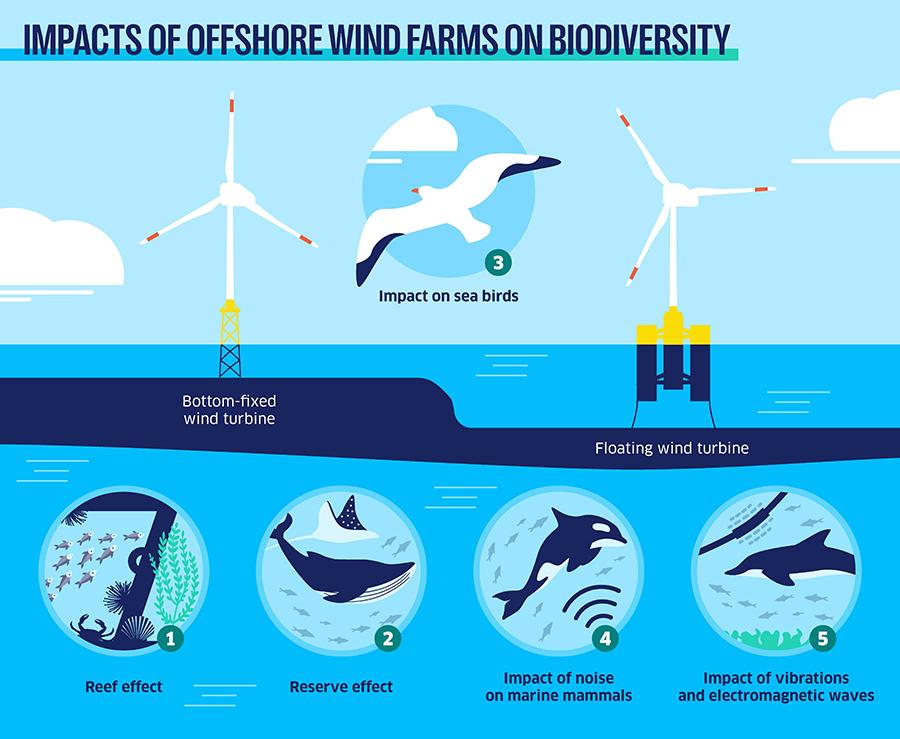
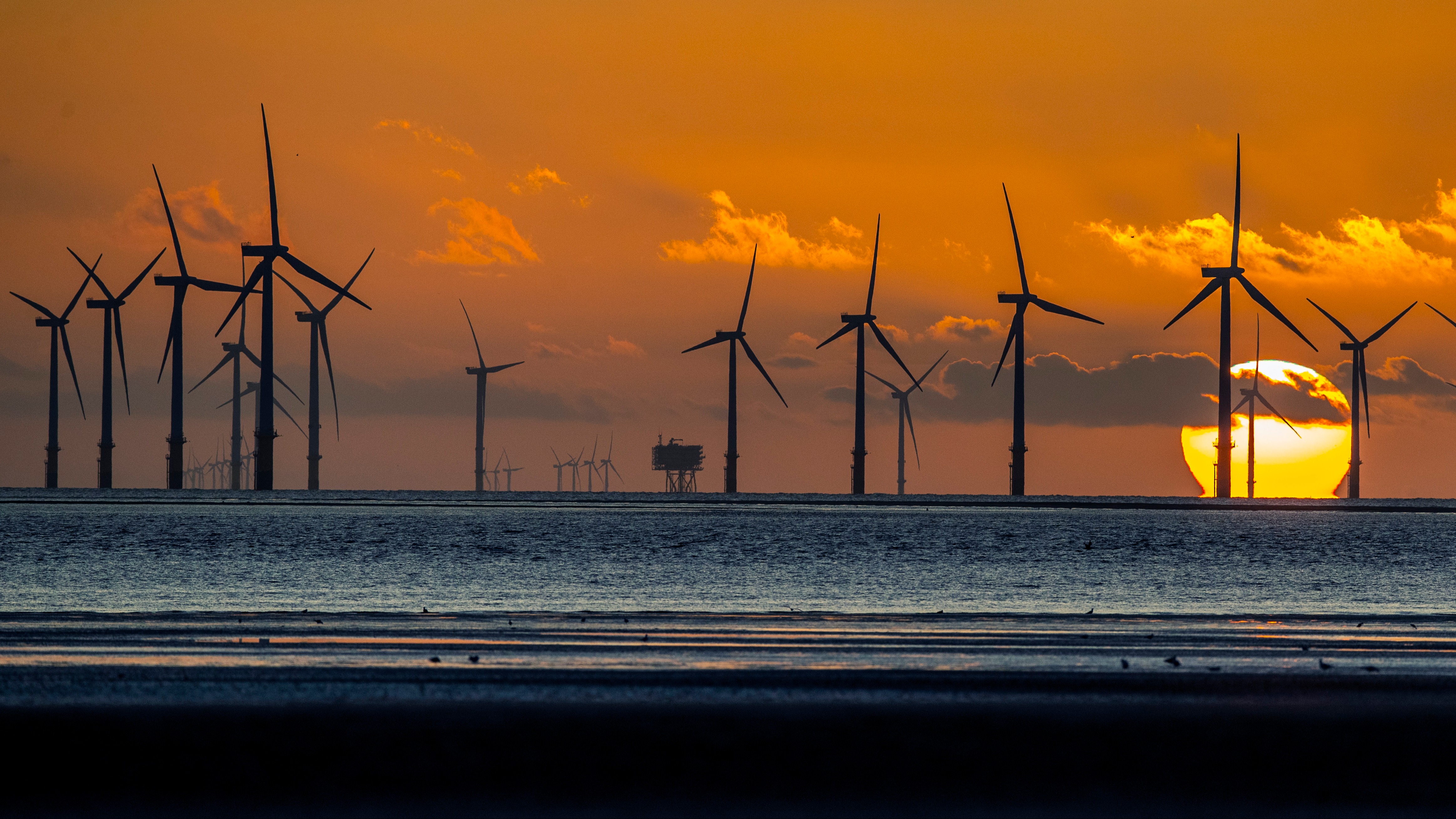
Wind farms located offshore will also impact fish and other marine wildlife. Some studies suggest that turbines may actually increase fish populations by acting as artificial reefs.
The impact will vary from site to site, and therefore proper research and monitoring systems are needed for each offshore wind facility.
Sound and visual impact are the two main public health and community concerns associated with operating wind turbines. Most of the sound generated by wind turbines is aerodynamic, caused by the movement of turbine blades through the air.
There is also mechanical sound generated by the turbine itself. Overall sound levels depend on turbine design and wind speed.
Some people living close to wind facilities have complained about sound and vibration issues, but industry and government-sponsored studies in Canada and Australia have found that these issues do not adversely impact public health.
It is important for wind turbine developers to take these community concerns seriously by following good neighbor best practices for siting turbines and initiating open dialogue with affected community members.
Additionally, technological advances, such as minimizing blade surface imperfections and using sound-absorbent materials can reduce wind turbine noise.
Under certain lighting conditions, wind turbines can create an effect known as shadow flicker. This annoyance can be minimized with careful siting, planting trees or installing window awnings, or curtailing wind turbine operations when certain lighting conditions exist.
The Federal Aviation Administration (FAA) requires that large wind turbines, like all structures over 200 feet high, have white or red lights for aviation safety.
However, the FAA recently determined that as long as there are no gaps in lighting greater than a half-mile, it is not necessary to light each tower in a multi-turbine wind project. Daytime lighting is unnecessary as long as the turbines are painted white.
When it comes to aesthetics, wind turbines can elicit strong reactions. To some people, they are graceful sculptures; to others, they are eyesores that compromise the natural landscape.
Whether a community is willing to accept an altered skyline in return for cleaner power should be decided in an open public dialogue.
While there are no global warming emissions associated with operating wind turbines, there are emissions associated with other stages of a wind turbine’s life-cycle.
Including materials production, materials transportation, on-site construction and assembly, operation and maintenance, and decommissioning and dismantlement.
The world installed 116 gigawatts of new wind power capacity in 2023, according to the latest Global Wind Report from industry trade association the Global Wind Energy Council (GWEC).
China led for both offshore and onshore wind installation followed by the USA, Brazil and Germany. Thanks to strong growth in the Netherlands, Europe also had a record year in 2023 with 3.8 gigawatts of new offshore wind capacity.
The report notes that, while wind power growth is highly concentrated in a few big countries, some other regions and nations saw record growth.
Africa and the Middle East installed nearly 1 gigawatt of wind power capacity in 2023, almost triple that of the previous year.
Seven countries now generate all of their energy from renewable sources, according to figures from the International Energy Agency (IEA) and International Renewable Energy Agency (IRENA).
More than 99.7% of electricity in Albania, Bhutan, Ethiopia, Iceland, Nepal, Paraguay and the Democratic Republic of Congo comes from geothermal, hydro, solar or wind power.
Another 40 countries got at least half of their electricity from renewables in 2021 and 2022 including 11 in Europe. Others, like Germany or Portugal, are capable of running on 100% wind, water and solar for short amounts of time.
Though many of these countries currently use a large amount of hydro-power or wind energy, experts predict solar could take over as a major source in the near future. Technology has improved and costs are rapidly dropping.
Solar dominated the expansion of renewable energy capacity in 2023, accounting for 73% of all growth, followed by wind power at 24%. It now makes up 37% of the world’s total renewable energy capacity.
A 2023 study from the University of Exeter and University College London predicts that solar will reach an irreversible tipping point, becoming the world’s primary source of energy by 2050.
The U.S. Fish and Wildlife Service has been exceedingly slow to protect species. A 2016 study found that species waited a median of 12 years to receive safeguards. In total, at least 47 species have gone extinct waiting for protection.
Several of the species in today’s announcement went extinct during a delay in the listing process, including the Guam broad-bill, little Mariana fruit bat, and the southern acorn-shell, stirrup-shell and upland comb-shell mussels.
We are at risk of losing hundreds more species because of a lack of urgency. The Endangered Species Act is the most powerful tool we have to end extinction, but the sad reality is that listing still comes too late for most species.
The U.S. Fish and Wildlife Service badly needs to reform its process for protecting species to avoid further extinctions, and it needs the funding to do so. We can’t let bureaucratic delays cause more extinctions.
Nine months into his term, President Biden has yet to nominate a director for the Fish and Wildlife Service.
Biden did request more than a $60 million increase for endangered species — the largest increase requested for the program in history — but the House Appropriations Committee undercut the president’s budget request by $17 million.
A 2016 study found that Congress only provides approximately 3.5% of the funding that the Service’s own scientists estimate is needed to recover species. Roughly 1 in 4 species receives less than $10,000 a year toward recovery.
Instead the U.S. Fish and Wildlife Service proposed today to remove 22 animals and a plant from the endangered species list because of extinction. They join the list of 650 U.S. species that have likely been lost to extinction.
Species being proposed for de-listing include the ivory-billed woodpecker, Bachman’s warbler, Scioto mad-tom, San Marcos gambusia, eight species of Southeastern freshwater mussels, eight birds and a flower from Hawaii, and a bird and bat from Guam.
Two bills moving through Congress would increase protection and funding for endangered species. The Extinction Crisis Emergency Act would direct President Biden to declare the global wildlife extinction crisis a national emergency.
The Extinction Prevention Act (H.R. 3396) would create four grant programs that would provide $5 million per year to fund crucial conservation work for each of the most critically imperiled species in the USA, including butterflies, freshwater mussels, desert fish and Hawaiian plants.
The legislation would spur action across the entire federal government to stem the loss of animals and plants in the United States and around the world.
Extinction is not inevitable. It is a political choice. Saving species isn’t rocket science. As a country we need to stand up and say we aren’t going to lose any more species to extinction.
Bachman’s warbler was a small yellow and black songbird that once bred in swampy thickets in Alabama, Florida, Georgia, North Carolina, South Carolina and Tennessee and overwintered in Cuba, where it was seen for the last time in 1988. It was lost to habitat destruction and collection.
Bridled white-eye: A green, yellow and white tropical lowland forest bird from Guam that was 4 inches long, with a prominent ring around its eye. It became extinct because of predation from the invasive brown tree snake.
Ivory-billed woodpecker: The third largest woodpecker in the world, the ivory-billed woodpecker once flew in old-growth forests in 13 states, including Arkansas, Florida, Georgia, Illinois, Kentucky, Louisiana, Mississippi, Missouri, North Carolina, Oklahoma, South Carolina, Tennessee and Texas.
It declined because of logging and collection, and the last verified sighting was in 1944 despite extensive searches.
Little Mariana fruit bat: Also known as a flying fox, the little Mariana fruit bat lived on Guam and foraged on tropical fruits.
It was last seen in 1968 and went extinct because of habitat loss from agriculture and military activity, brown tree snake predator and over-harvesting for use as food. It had a 2-foot wingspan, gold on the sides of its neck and yellowish-brown fur on the top of its head.
The San Marcos gambusia was a 1-inch-long fish that ate small invertebrates and gave birth to live young instead of laying eggs like many species of fish.
It lived in clear spring water from the headwaters of the San Marcos River in Texas.
Last seen in 1983, its extinction is due to water overuse that depleted groundwater and spring flow.
The Scioto madtom was a small catfish found only in Big Darby Creek in Ohio. It was listed as endangered in 1975 but was last seen in 1957. It was lost because of silt accumulation from dams and runoff.
The eight freshwater mussels proposed for de-listing include the flat pig-toe, green-blossom pearly mussel, southern acorn-shell, stirrup-shell, tubercles-blossom pearly mussel, turgid-blossom pearly mussel, upland comb-shell and yellow-blossom pearly mussel.
Freshwater mollusks are the most endangered group of organisms in the United States, with 36 mussels and more than 70 freshwater snails already lost.
Global Research California / ABC Flash Point News 2021.
Hundreds of sightings, abductions and first-hand accounts have made it possible to distinguish several distinct alien species that have been in cahoots with military forces, deciding our future without ever consulting us.
All these assumptions were taken from historical texts, myths, abduction experiencers, and other sources. Below are the least obscure ones we could find ;
The Tall Grays
Standing 7 to 8 feet tall, the Gray Masters are the ambassadors of most meetings between human and alien forces. They are always present at any diplomatic agreements with the global shadow government.
Sources claim they originate from a star system in the Orion constellation.
The Tall Grays supervise all abductions and human experiments but are seldom present during these events.
They prefer to employ the services of their minions, the Short Grays. As it would seem, they are keen on developing a stable human-gray hybrid race, one worthy of inheriting Earth.
An advanced, self-centered race, they place little value on human life. They consider us their property.
The Short Grays
Also known as the Zeta Reticulums, the Grays are some of the most well-known aliens and commonly depicted throughout alien pop culture.
They are the authors of most alien abductions.
According to most descriptions, they stand 3 to 5 feet tall, have bulbous heads and over-sized black eyes. Although they possess a mouth, they seldom speak, as most communication is carried out telepathically.
The short Grays are said to be a genetically-engineered worker race that are controlled by their superiors, the Tall Grays. Their telepathic abilities allow them to constitute a type of hive mind consciousness.
Being genetically-designed to carried out scientific missions, the short Grays are emotionless and cruel. They are also responsible for creating a human-gray hybrid race.
The Sirians
Hailing from the Sirius B star system, the Sirians are as advanced as they are ancient. Throughout history, they have imparted their knowledge to human civilizations of their choosing.
They gifted the ancient Egyptians with medical and astronomical information and the great pyramids and temples are said to have been built with their help.
The Mayans also had a special relationship with the Sirians, who shared information with this enigmatic South American civilization.
The extraterrestrial originating from Sirius B are believed to have played a part in the disappearance of the Mayan culture.
Another earthly civilization that benefited from the Sirian presence were the Atlanteans; it is believed that during the cataclysmic event that sunk Atlantis, the Sirians were instrumental in leading the rescue operations.
Other civilizations have been influenced by the Sirians, the most notable case being that of the Dogon tribe of West Africa. Although they were more involved during our planet’s past, nowadays the Sirians play a more subtle part: technology exchange programs.
They are often mentioned in connection with covert or exotic weapons research as well as time travel experimentation.
Sinds de begin dagen van mijn toetreden tot Vista Royal IIIb werden mijn rechten met handen en voeten overtreden. Vele getuigen rusten nu op het kerkhof, sinds in 2001 Narcotica agenten de woning op VR/H2 volpompten met lood, nadat zij als inbrekers VR/H5 door mij werden betrapt op huisvredebreuk.
Mij waarschuwingen aan deze inbrekers werden met een regen van kogels beantwoordt. Toendertijd was dhr Ras het hoofd van de technische dienst van destijds het KPA, nu KPC. De vele kogelgaten in de woning van VR/H2 werden bevestigd door tientallen legen hulzen in de toenderijd nog schaars bewoonde buurt.
Sluiten bankrekeingen HBU/Deutsche Bank :
Sindsdien werd mijn leven totaal ontspoord en werden al mijn bezittingen op scherp gezet, buitenlandse bankrekeingen van mijn bedrijven Hebacu NV, Macfinin Ltd en Abna Advies NV zonder enige vorm van kennisgeving prompt gesloten om mijn inkomsten te blokkeren en teniet te doen.
Ook verdween er fl.250.000 van een van mijn bankrekeningen bij toendertijd de HBU/ABN, de accountant die de adminstratie moest tonen om bij de ABN/HBU een klacht in te kunnen dienen voor het verdwijnen van 90k euro, werd plostseling in coma en half dood in de mondi van Bonaire aangetroffen.
Hij werd van achteren aangereden door een onbekende vehicle, maar daar volgde verder geen politie onderzoek na, de beste man en mijn vriend Paul Christiaan Bakker werd door zijn broers maar in NL begraven en euthanasie in het Sint Elizabeth Hospitaal op Curacao, waar hij van life support werd ontbonden.
Klachten bij de NL’se Bank en andere toezicht organisaties om het verdwenen ABN/HBU geld op te sporen, werden door deze wel in behandeling genomen, maar leverde verder geen resultaat op, behalve dat de bewindvoerders mij adviseerden om deze zaak verder met een advocaat af te handelen.
Deze stap heeft nooit meer plaats kunnen vinden en/of gevonden om de reden dat wij geen behoefte hadden om goed geld achter slecht geld aan te gooien.
Om mijn geloofwaardigheid verder te ondermijnen werden NL’se agenten naar Blue Bay gestuurd om dit Curacaosche Golf Kampioenschap voor heren, dames en jeugd te ontwortelen en uiteindelijk af te sluiten door medewerkingen van Daan Vos en Rogier van der Meer (Chogogo/Blue Bay)
De slogun SMILE Golf (SMILE staat/stond voor “Shoco Matchplay Invitational Lustrum Edition”) werd vervolgens door de ontwikkelaars op Jan Thiel (dhr Schellevis/Chogogo/TUI) overgenomen. DEA agent Eric Letang was hier de spil in.
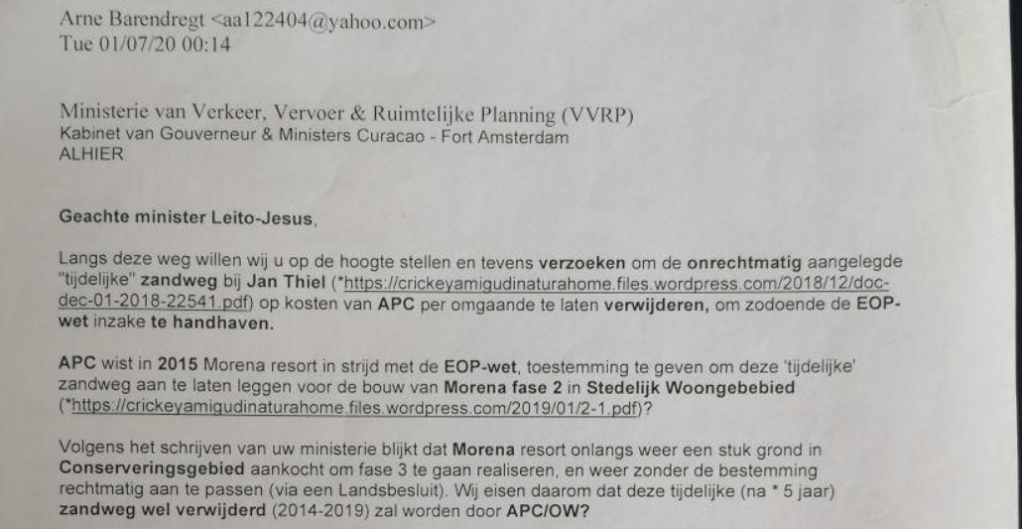
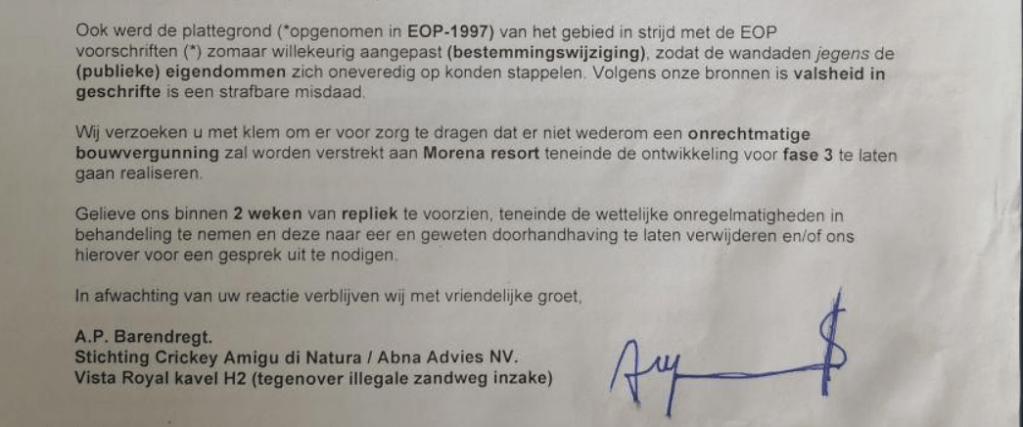
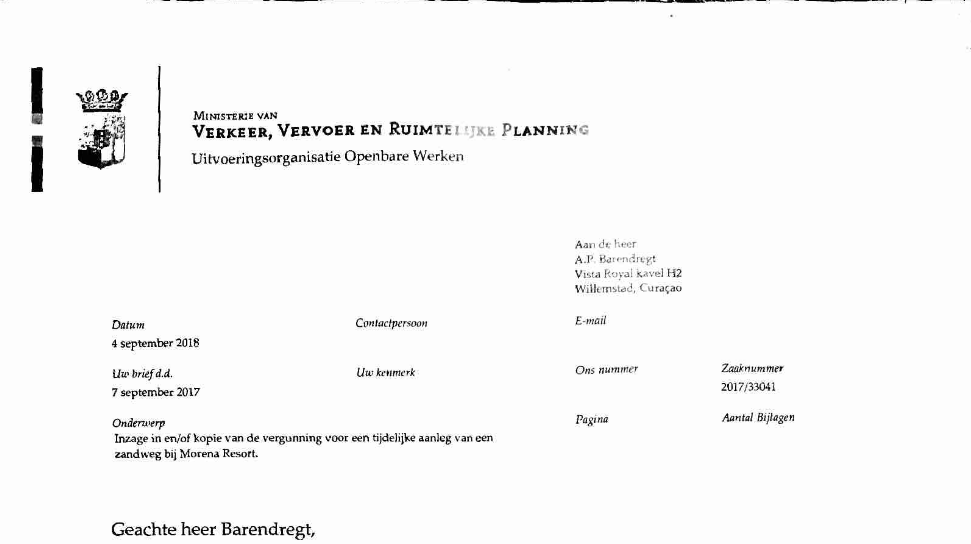
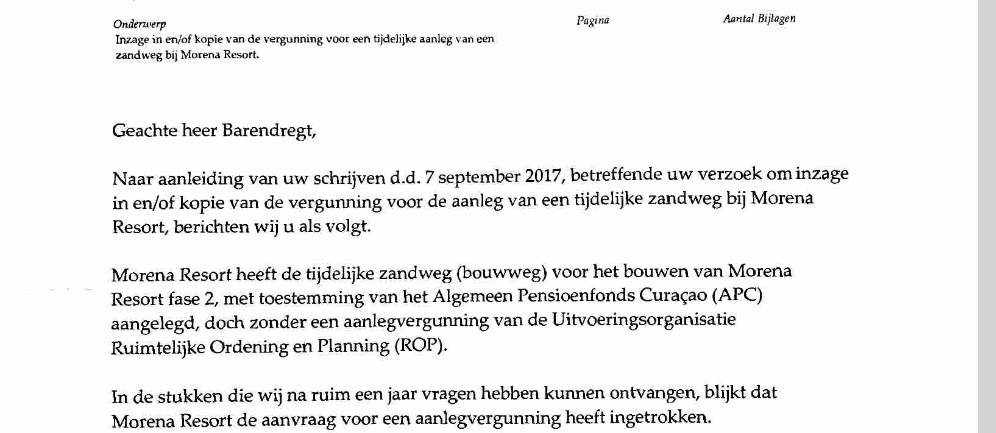
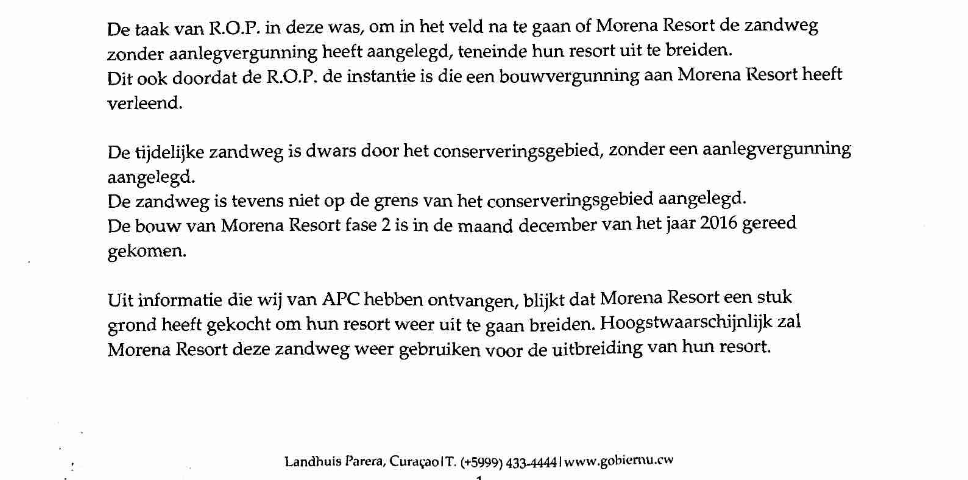
Ook mochten de vervolgens Papagayo/Morena/Chogogo in 2008 een stuk grond in conserveringsgebied, wettelijk vastgelegd in geldende EOP 1997 vastgelegd, waarbij een Bestemmingswijziging nimmer in een Landsbesluit werd vastgelegd door de PAR regering.
Landkaarten werden dus vervalst en voor zoete koek genomen, om de bijbouw in 2008 te kunnen laten plaatsvinden. Omdat alle documentatie via LOB verzoeken door Stichting Crikey Amigu di Natura werd vastgelegd, werd mij letterlijk en figuurlijk de oorlog verklaard, waarbij carte blanche werd werd aangenomen om mijn belangen en bewijzen aan de kant geschoven te krijgen.
Rechtzaak Morena/Abna Advies NV om geluidsoverlast voor de woning van VR/H2 te beperken :
In 2008/09 werd hier door de rechter bepaald dat in een straal van 100 meter geen bouwactiviteiten meer mochten plaatsvinden rondom de woning van VR/H2.
Sluiten bankrekening Wells Fargo (WF) en Banco Popular Puerto Rico (BPPR) :
In 2019-2020 werden de prive bankrekeningen van BPPR op scherp gezet, nadat er klachten werden gelanceerd inzake witwassen van geld. het ging hier om enkele transacties van 100 euro?
Aan de WF account zaten drie safe deposit box verbonden, De bankrekening werd gesloten zonder enige vorm van waarschuwing en/of uitleg. Documenten en waardevoll collecties gingen verloren. Via de Florida claim system was het nog wel mogelijk een bedrag twv $42K te achterhalen en terug te vorderen.
Huurders VR/H24 ingezet om bewoner VR/H2 met grof geweld te verwijderen door geluidsoverlast :
Deze episode kan in de aangifte (KPC dd ……..) worden bekeken.
Aanval op mijn persoon door Belgische bouwvakkers VR/H3 :
Aangifte gedaan dd 10 April 2021.
Roddel op straat over moord plaatsgevonden in de woning van VR/H2 :
Klein Curacao specialisten die met limosine’s rondrijden hadden de directeur dood aangetroffen in haar wonng op Vista Royal, maar dat wordt nu voor het gemak zomaar in mijn schoenen geschoven?
CONCLUSIE :
Aanslagen en terreur wordt niet geschroomd om levenskwaliteit en gezondheid ernstig te blijven ondermijen door betrokken netwerken. Advies gekoppelde derden, verkoop VR/H2 en verdwijn van Curacao om ergens anders een nieuw leven op te bouwen?
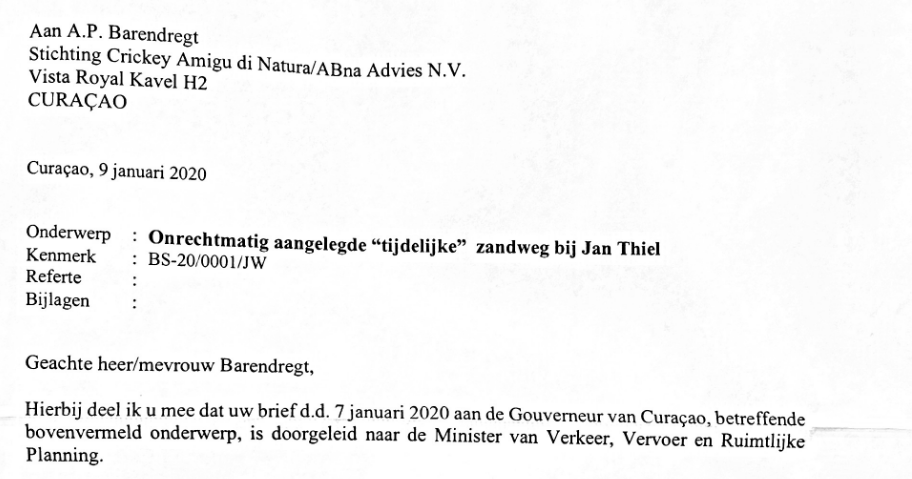
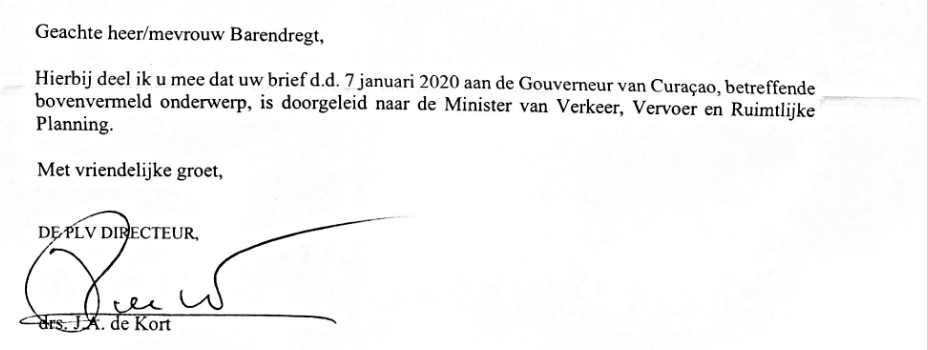
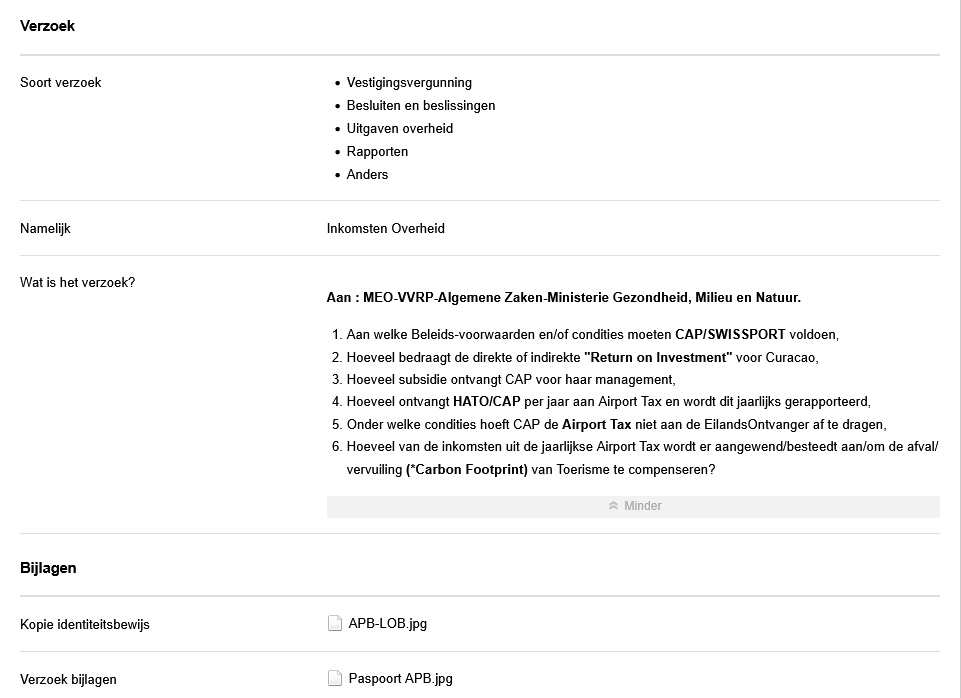
Bedankt voor het aanvragen van een Landsverordening openbaarheid van bestuur (LOB) verzoek. Uw registratie is bij ons bekend onder zaaknummer 604693, dd 29/12/2025.
Voorwaarden
Afwijzen van een “LOB-verzoek” (P.B. 1995 no. 211/A.B. 2010 no. 87 artikel 11)
De overheid kan uw verzoek afwijzen, indien één van de uitzonderingen van de “Landsverordening Openbaarheid van Bestuur (LOB)” van toepassing is.
Bijvoorbeeld wanneer het verstrekken van de informatie de veiligheid van Curaçao schaadt of wanneer het gaat om vertrouwelijke persoons- of bedrijfsgegevens.
Griffierecht bij bezwaar (P.B 2001 no. 79)
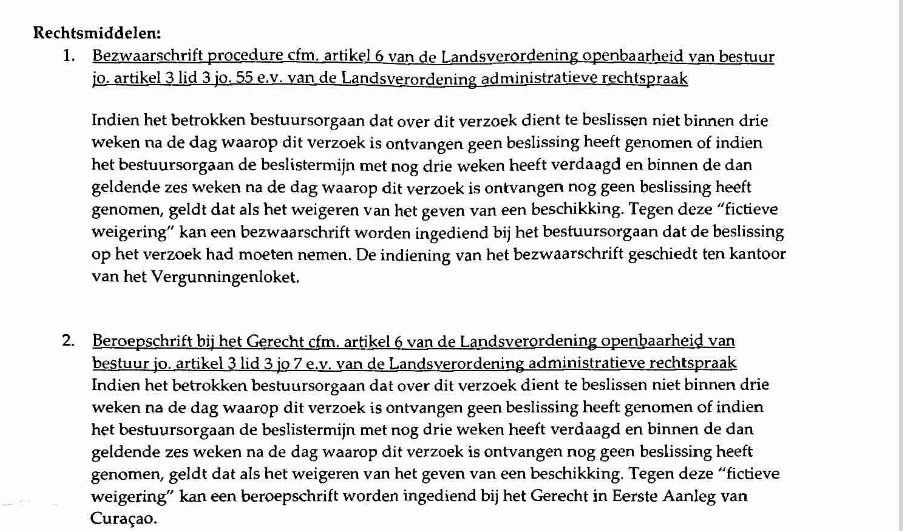
Beslist de overheid niet op tijd (uiterlijk binnen 6 weken)? Of wordt uw verzoek afgewezen? Dan kunt op basis van de Landsverordening Administratieve Rechtspraak (LAR) beroep aantekenen.
Dit kan binnen 6 weken nadat het antwoord is ontvangen, of nadat u het antwoord niet heeft ontvangen. Voor het indienen van een beroepschrift moet u ANG 150,– aan griffierecht betalen bij het gerecht.
Landsverordening openbaarheid van bestuur (LOB) verzoek. Uw registratie dd 27/12/2025 is bij ons bekend onder zaaknummer 603472.
Indien Bestuursorgaan weigert een beschikking af te geven, kan na 6 weken bezwaar aangetekend worden bij Vergunningen Loket.
Beslist de overheid niet op tijd (uiterlijk binnen 6 weken)? Of wordt uw verzoek afgewezen? Dan kunt op basis van de Landsverordening Administratieve Rechtspraak (LAR) beroep aantekenen.
Dit kan binnen 6 weken nadat het antwoord is ontvangen, of nadat u het antwoord niet heeft ontvangen. Voor het indienen van een beroepschrift moet u XCG 150,– aan griffierecht betalen bij het gerecht.
Voorwaarden
Afwijzen van een “LOB-verzoek” (P.B. 1995 no. 211/A.B. 2010 no. 87 artikel 11)
De overheid kan uw verzoek afwijzen, indien één van de uitzonderingen van de “Landsverordening Openbaarheid van Bestuur (LOB)” van toepassing is.
Bijvoorbeeld wanneer het verstrekken van de informatie de veiligheid van Curaçao schaadt of wanneer het gaat om vertrouwelijke persoons- of bedrijfsgegevens.
At least 800 people were reportedly killed in Ethiopia as worshipers and soldiers risked their lives to protect what Christians there say is the sacred Ark of the Covenant from assailants.
Ethiopian Christians claim the Ark, the wooden chest built to hold the Ten Commandments of Moses, is being kept safe in a chapel in the holy northern city of Axum in the Tigray region.
The Church of St. Mary of Zion in Axum, Ethiopia, where the sacred Ark of the Covenant is believed to be housed.
The battle between Ethiopian soldiers and mercenaries happened in the fall of 2020, The Sunday Times reported, but it is only being reported now.
When people heard the shooting they ran to the church to give support to the priests and others who were there protecting the ark.
Little was known about the deadly siege since Tigray is cut off from the world and journalists had been blocked from entering the region.
A deacon residing in Axum told the Associated Press he helped count the bodies, gathered victims’ identification cards and assisted with burials in mass graves.
He believes that an estimated 800 people were killed at the church and around the city.
If you attack Axum, you attack first of all the identity of Orthodox Tigrayans but also of all Ethiopian Orthodox Christians, Wolbert Smidt, an ethnohistorian who specializes in the region.
The Patriarch of the Orthodox Church of Ethiopia announced that on Friday, June 26, 2009, he will unveil to the world the Ark of the Covenant.
There has been a legend for many years that the Ark of the Covenant is in the Saint Mary of Zion Church in Axum, Ethiopia.
In recent years this legend has been popularized in the writings of Grant Jeffrey, a Canadian Bible prophecy writer who often specializes in the sensational.
This legend is based on a bizarre story that the Ark was smuggled out of Jerusalem by Menelik I, the supposed son of a union between the Queen of Sheba and King Solomon.
Supposedly, a replica of the Ark was left in the Holy of Holies in the Temple in Jerusalem. The motivation for moving the Ark was to protect it from King Manasseh, one of the most ungodly kings in the history of Judah.
There are all kinds of problems with this legend. For one thing, it is doubtful that the Queen of Sheba ruled over Ethiopia. It is more likely that her realm was modern day Yemen.
At that time there was a dispute over who should be king, and one of the contenders claimed to be a descendant of King Solomon and the Queen of Sheba.
The insurmountable problem with the Ethiopian legend is that 2 Chronicles 35:3 states that the Ark was still in the Temple during the time of King Josiah who reigned from 640 to 609 B.C.
That passage makes it clear that the Ark was still in existence at the time of the spiritual revival led by the boy king, Josiah. Within 22 years after Josiah died, Judah fell to the Babylonians (586 B.C.), and the Ark disappeared.
No one knows for sure what happened to the Ark. Some scholars believe it was simply destroyed when the Temple was burned. Others believe it was captured as a prize of war, taken to Babylon, and probably melted down for its gold.
The strongest tradition is that the Ark was taken out of the Temple by Jeremiah and hidden. Some are convinced he hid it in the ground on the Temple Mount.
But most who hold to the Jeremiah rescue theory believe he either hid the Ark in a great cavern beneath the Temple Mount (known today as Solomon’s Quarry) or that he hid it somewhere near Mt. Nebo in the modern day nation of Jordan.
Air New Zealand scrapped its 2030 carbon emissions reduction targets this week, citing delays in building new planes, a lack of alternative fuel and challenging regulations and policies.
This news reinforces what we already know – that the aviation industry cannot be trusted to reduce their own emissions, says campaign group Stay Grounded. New Zealand’s national carrier is one of the country’s biggest companies by revenue and profits.
Tourism is New Zealand’s 2nd largest export earner, driven by images of the country’s pristine and scenic vistas. The Five-Eyes country pledged a 28.9% reduction in carbon emissions by 2030, from a 2019 baseline, with a 16.3% drop in absolute emissions.
Its withdrawal from the Science Based Targets initiative (SBTi) was the highest-profile reversal yet of an airline’s commitments to a UN framework for corporations to stay on track to meet the Paris Agreement on emissions reductions.
If even Air New Zealand can’t do it, it kind of cements the reality that reducing emissions from aviation is an impossible task under the current technical regime, says James Higham, a sustainable tourism expert at Griffith University in Australia.
The carrier would establish new near-term emissions reduction targets that would better reflect the challenges relating to aircraft and alternative jet fuel availability, CEO Greg Foran said in a written statement.
Global manufacturing and supply chain issues could slow the introduction of more fuel-efficient planes into Air New Zealand’s fleet. The affordability and availability of alternative jet fuels and global and domestic policy settings are also outside the airline’s direct control.
What we see here is a trend within the aviation industry – they repeatedly fail to meet environmental targets and then ask us to trust them again next time, says Stay Grounded.
The only solution that will actually allow Air New Zealand to adequately reduce their emissions is to stop their growth plans and massively reduce the number of flights that take off each day!
Only six of the 27 EU member states have submitted national climate plans that are up to scratch. 12 EU nations are set to miss their national climate targets under the Effort Sharing Regulation (ESR), according to a study analyzing national climate plans.
Another seven are at risk of not meeting their goals. If they don’t meet their required emissions reductions, they may have to pay financial penalties.
Air travel makes up about 2.5% of global carbon emissions, but it’s one of the most carbon-intensive activities per passenger. Without intervention, CO2 emissions from commercial aircraft are on course to triple by 2050 according to SBTi.
Other airlines listed on the SBTi database as having removed their commitment to near-term emissions goals included United Airlines, the German carrier Lufthansa, Britain’s easyJet, LATAM Airlines Chile and Japan Airlines.
Stay Grounded argues that what’s needed is strong government regulation to deter people from flying, such as a frequent flyer levy, a tax on kerosene, airport caps and an end to all airport expansion.
The ESR is a policy framework – part of the EU’s climate and energy package – that sets binding national greenhouse gas targets for the 27 member states. It requires them to collectively cut emissions by 40% (compared to 2005) by 2030.
Member states have to meet climate targets for five key sectors: road transport, buildings, small industry, waste and agriculture. Each goal is adjusted based on a country’s GDP with richer nations having stricter requirements.
The report from Transport & Environment (T&E) found that the two worst-performing countries are Germany and Italy. Germany is projected to miss its climate targets by 10% and Italy by 7.7%.
Compared to pre-2008 crisis levels, world economic growth has plummeted by half and is at risk of a long-term, hard-to-reverse stagnation.
The longer the US Sino-Tariff Wars go on, the harder it will be to undo the damage, because the consumer pays the increased (extra tariff-tax) price and with that, the buying power of the American people will further collapse.
Since spring 2017, the US-led tariff wars have effectively undermined the global recovery. In the past years, global economy has navigated across several scenarios. Now it is approaching the edge.
We have been following four generic scenarios on the prospects of global economic growth since the U.S. 2016 election.
The first two scenarios represent variants of “re-coupling.” In these cases, global integration prevails, despite tensions.
In the next two scenarios, global integration will fail, either in part and regionally or fully and globally.
What should worry us all is that, during the past few years, real global growth prospects have slowly but surely moved from the ideal and preferable scenarios toward the worst and darkest.
The Return to Cooperation Scenario
In this scenario, USA and China achieve a trade agreement. Both agree to phase out additional tariffs, renounce trade threats and establish working groups to defuse other friction areas in intellectual property rights, social and political issues, and military matters.
Global growth prospects could – in the best scenario – even exceed the old OECD/IMF baselines at more than 4%.
This was always the least likely scenario to materialize. Today, its degree of probability is minimal. Yet, it is important to remember that, during the first Trump-Xi meeting, many observers saw the scenario still as possible, even probable.
The Muddling Through Scenario
In this scenario, the tariff’s economic impact would have been limited to 0.4% of Chinese GDP and 0.8% of USA GDP, respectively. US regime and China develop a path to a trade agreement during the truce, but other friction areas, particularly in advanced technology, result in new skirmishes.
Uncertainty decreases but fluctuates. Global economic prospects barely improve. Markets witness rallies and plunges. Global recovery fails. Global growth prospects remain close to 3.5%-3.9%.
Only half a year ago, this scenario was still seen as a viable one. Today, it feels like a bygone world.
The America First Scenario
In this scenario, the import-value stakes would be 10-fold relative to the start of the trade war, amounting to more than $0.5 trillion, with soaring collateral damage. In China, it could shave off 0.4% and in the USA 0.8% of the 2019 GDP, respectively.
Neither the USA nor China would agree to phase out additional tariffs. Talks would linger, fail or lead to new friction. Uncertainty increases, volatility returns. Global prospects decline further. Markets linger.
In this scenario, global prospects would dampen as world GDP growth in 2019 would sink to 3% or worse.
Toward the Edge
So where are we today vis-à-vis these scenarios? A simple answer: Moving closer to the edge. After trade frictions and the Trump tariffs undermined the global recovery momentum, the IMF finally woke up predicting global economic activity to slow notably.
In early June, the World Bank estimated the world economy would only expand by 2.6%. The IMF has affirmed that the trade wars could wipe $455 billion off global GDP in 2020.
Worse, President Trump increased tariffs on $200 billion worth of Chinese goods exported to the USA and introduced an effective ban on American companies doing business with Chinese telecom giant Huawei in early May.
In brief, the status quo is shifting from the America First toward the Global Trade War scenario.
In effect, multilateral banks’ estimates still downplay effective collateral damage.
If the Trump administration will continue to expand trade wars and geopolitical ploys in multiple regions, their models ignore the impending adverse feedback of such measures—as evidenced by Morgan Stanley’s business conditions index that just took the worst one-month hit in its history.
To understand how much expectations have been revised, let’s recall that before the 2008 global crisis global growth rate was around 4% to 4.3%. The current growth rate has almost halved from its pre-crisis level.
In relative terms, something similar occurred in the 1970’s, which saw the end of three “glorious decades” of solid growth in major advanced economies.
What we are witnessing now is a potentially fatal fall into secular stagnation. In part, it is structural, resulting from maturing economies and aging populations.
But in part, it is self-induced and the effect of misguided trade policies and unilateral geopolitical aggression. In the absence of tariff wars and geopolitical destabilization, global growth rate could now be closer to 3.5%.
The longer it takes to achieve multilateral reconciliation, the more likely it is that falling secular long-term growth rates will prove harder to reverse.
South China Morning Post / Foreign Policy Journal 2019.








































 Crickey Amigu di Natura